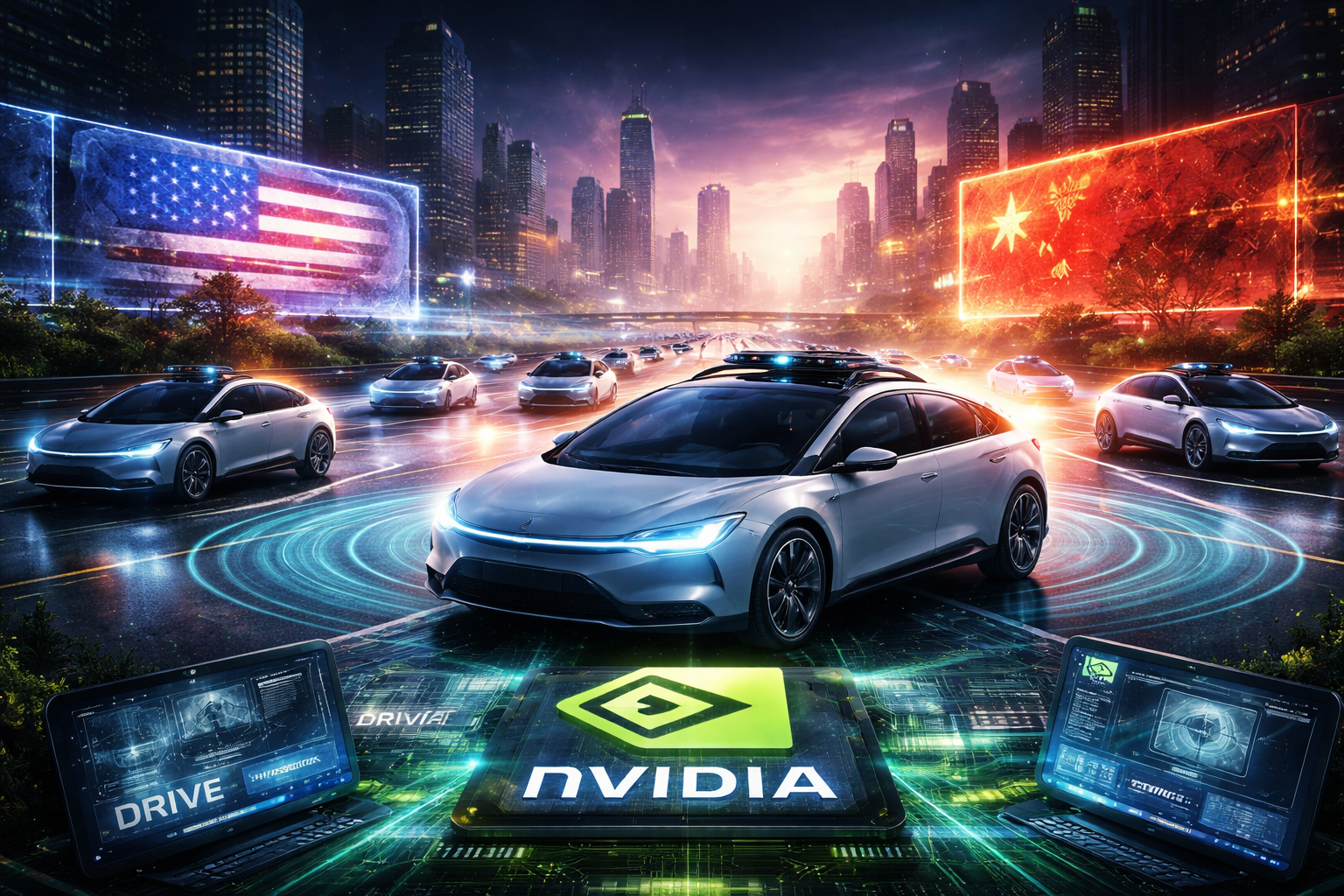
Nvidia's Hyperion Gambit: Powering China's Robotaxi Revolution and Redefining Global Mobility
Key Takeaways
- Nvidia's Drive Hyperion platform is setting a new ecosystem standard, moving beyond chip sales to foundational system integration
- Strategic partnerships with Chinese giants BYD and Geely accelerate global autonomous vehicle adoption, consolidating data and market share for Nvidia
- The robotaxi surge in Asia signals a pivotal shift in urban transit, prompting critical analysis of regulatory frameworks, ethical AI, and societal transformation.
The future of urban transit isn’t arriving; it’s already in motion, powered by unseen algorithms and silicon ambition. Nvidia, a titan of computation, has just declared a significant leap forward, not just for its bottom line, but for the very fabric of our cities. Their announcement that Chinese automotive giants BYD and Geely will adopt the Drive Hyperion robotaxi platform isn’t merely a business deal; it’s a strategic maneuver that reverberates through the global tech landscape, signaling a new era of autonomous dominance and intricate geopolitical interplay.
Nvidia’s Hyperion Gambit: Beyond the Silicon Frontier
At its core, Nvidia’s Drive Hyperion is not just a collection of chips. It’s an end-to-end architecture: a comprehensive, scalable platform encompassing high-performance AI compute, advanced sensor suites, and a robust software stack designed for Level 4 autonomous driving. This isn’t just providing the engine; it’s providing the entire blueprint for an autonomous future. By offering a fully validated hardware and software reference design, Nvidia dramatically lowers the barrier to entry for automakers, allowing them to focus on vehicle design and integration rather than reinventing the foundational AI stack. This strategy echoes their prowess in the AI data center, where their GPUs and CUDA ecosystem became the de facto standard, effectively establishing a powerful ecosystem moat.
The Dragon’s Embrace: Why BYD and Geely Matter
The inclusion of BYD and Geely is a monumental win, extending Nvidia’s reach deep into the heart of the world’s most dynamic automotive market: China. BYD, a formidable force in electric vehicles, is rapidly expanding its global footprint, while Geely, the parent company of Volvo and Lotus, commands a vast and diverse portfolio. These aren’t minor players; they are innovators at the forefront of the EV revolution, poised to become global leaders. Moreover, their selection alongside other significant players like Isuzu and Nissan underscores the global appeal and perceived robustness of the Hyperion platform.
This collaboration signifies several critical shifts:
- Market Penetration: It grants Nvidia unparalleled access to the rapidly expanding Chinese ride-hailing and autonomous logistics sectors. China’s immense population density and government support for advanced technology make it an ideal testbed and scaling ground for robotaxi services, offering a fertile ground for early, high-volume deployment.
- Data Aggregation and Refinement: Every kilometer driven by a BYD or Geely robotaxi powered by Hyperion generates invaluable, real-world data. This data feeds back into Nvidia’s AI models, continually refining algorithms, improving safety protocols, and accelerating the platform’s overall capabilities. This creates a powerful, self-reinforcing feedback loop, solidifying Nvidia’s technological lead and making it increasingly difficult for competitors to catch up organically. The more miles driven, the smarter the system becomes.
- Ecosystem Lock-in and Strategic Influence: By integrating Hyperion at such a fundamental level, Nvidia effectively “locks in” these major automakers to its ecosystem. Switching platforms later becomes a prohibitively costly and complex endeavor, involving significant re-engineering and retraining. This grants Nvidia significant long-term influence, ensuring sustained revenue streams from software licenses, updates, and associated services, positioning them not just as a supplier, but as a critical infrastructure partner.
The Long Road Ahead: Navigating Autonomy’s Complexities
While the technological prowess and strategic partnerships are undeniably impressive, the journey to a fully autonomous world is fraught with challenges that extend far beyond silicon and code.
Regulatory Labyrinth and Ethical AI
Each city, province, and nation presents its own unique regulatory hurdles for autonomous vehicles. China, while forward-leaning in its ambitions, operates within its own complex frameworks, which may differ significantly from those in Europe or North America. Ensuring global interoperability and consistent safety standards will require unprecedented collaboration between tech companies, automakers, and governments. Furthermore, the ethical implications of AI making life-or-death decisions on the road remain a critical, ongoing discussion. Who is accountable when an autonomous vehicle makes a mistake? How do we program for nuanced human behavior and unpredictable scenarios, especially across diverse cultural contexts? Nvidia’s platform, and its partners, will inevitably be at the forefront of these profound ethical and legal debates.
The Competition Crucible and Geopolitical Currents
While Nvidia has made significant strides, the autonomous vehicle space is a fierce battleground. Competitors ranging from established tech giants like Intel (with Mobileye) to myriad well-funded startups are vying for market share and technological supremacy. The key will be not just raw processing power or sophisticated software, but the maturity of the entire solution, the robustness of the safety systems, and the ability to scale globally with regulatory compliance and public trust. Nvidia’s comprehensive platform approach offers a strong advantage, but complacency is a luxury no one in this hyper-competitive sector can afford. Moreover, the deep integration of a US-based semiconductor giant into core Chinese automotive infrastructure raises fascinating, and potentially complex, geopolitical questions regarding data sovereignty, supply chain resilience, and technological interdependence.
Societal Transformation and Job Displacement
The widespread deployment of robotaxis will inevitably lead to profound societal changes. Urban planning, public transportation networks, and even the very concept of car ownership could be radically reshaped. While proponents highlight increased efficiency, reduced traffic congestion, enhanced safety, and greater accessibility, the elephant in the room remains the potential displacement of millions of human drivers across ride-hailing, logistics, and delivery sectors. As avant-garde journalists, we must not shy away from asking: how will societies adapt to these seismic shifts, and what proactive measures are being put in place to manage this unprecedented economic and social transition?
The NexusByte Perspective: A Glimpse into Tomorrow
Nvidia’s pact with BYD and Geely is more than a headline; it’s a foundational tremor in the edifice of future mobility. It underscores a crucial inflection point where semiconductors meet sovereign strategy, and AI transcends mere computation to become the operating system of our physical world. For ‘The NexusByte’, this is a story of accelerating futures, where the lines between innovation and integration blur, and where critical thinking about long-term impact becomes paramount.
The shift isn’t just about faster chips or smarter algorithms; it’s about the strategic control of the data, the platforms, and ultimately, the intelligence that will orchestrate our daily lives. As autonomous vehicles transition from futuristic concepts to everyday realities, Nvidia is positioning itself as the unseen architect of this paradigm shift. We are witnessing the laying of digital railroads for the next century of transportation, and the stakes — technological, economic, and societal — could not be higher.