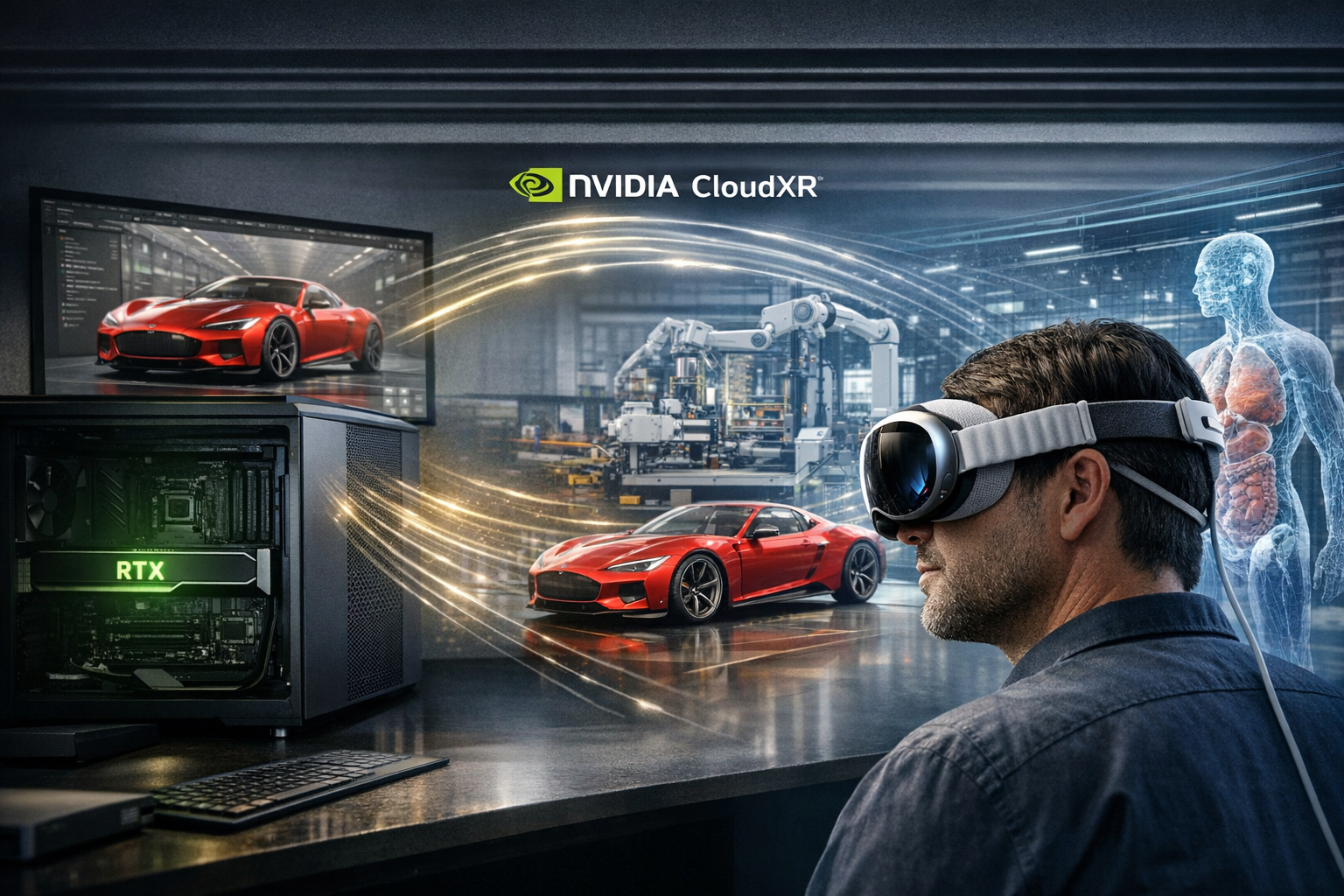
Spatial Convergence: How NVIDIA RTX Just Unlocked Apple Vision Pro's Enterprise Horizon
Key Takeaways
- High-fidelity spatial computing for enterprise is now critically enabled
- The hybrid compute model (cloud RTX + Vision Pro) becomes a new standard for performance
- Professional workflows in design, engineering, and simulation are on the cusp of a profound transformation
The Unseen Architecture: NVIDIA RTX, Apple Vision Pro, and the Dawn of True Enterprise Spatial Computing
For years, the promise of true spatial computing felt like a horizon perpetually receding. We’ve seen glimpses: enterprise VR solutions tethered by high-end PCs, AR overlays that struggle with fidelity, and consumer devices that hint at potential but lack the raw computational muscle for professional-grade tasks. But occasionally, a confluence of technological advancements occurs, a strategic alignment that fundamentally reshapes the landscape. This is one such moment.
The recent announcement — that NVIDIA RTX-accelerated computers now connect directly to Apple Vision Pro via native integration of NVIDIA CloudXR 6.0 into visionOS — isn’t merely a software update. It is a foundational architectural shift, a critical enabler that stitches together two of the most potent ecosystems in their respective domains. For the avant-garde tech observer, this isn’t just news; it’s a blueprint for the next decade of industrial innovation and immersive experience.
Beyond the Hype: Deconstructing the Strategic Alliance
At its core, this collaboration addresses a fundamental paradox in spatial computing: the need for immense processing power for high-fidelity graphics and complex simulations, juxtaposed with the desire for untethered, lightweight, and high-resolution immersive devices. Prior to this, achieving this often meant compromise: either a powerful, cumbersome local PC, or a cloud-streamed solution with potential latency and fidelity trade-offs.
NVIDIA CloudXR 6.0, now natively integrated into visionOS, is the elegant bridge. It securely delivers the computational prowess of NVIDIA RTX-powered servers – whether on-premise or in the cloud – directly to the Apple Vision Pro. This means applications demanding professional 3D graphics, such as Immersive for Autodesk VRED on Innoactive’s XR streaming solutions, can run with previously unattainable fidelity and responsiveness on Vision Pro.
This is not a casual partnership; it’s a strategic validation of a “hybrid” spatial computing paradigm. The heavy lifting of rendering photorealistic environments, simulating complex physics, or processing vast datasets remains with the NVIDIA RTX-accelerated machines. The Apple Vision Pro, with its industry-leading displays and sophisticated interaction model, becomes the ultimate viewing and interaction portal.
The Long Game: Impact on Professional Workflows
The immediate beneficiaries are clear: industries reliant on meticulous design, engineering, simulation, and training.
Engineering & Design: From CAD to Immersive Collaboration
Imagine product designers collaboratively reviewing a new automotive prototype, rendered in real-time with cinematic quality, able to walk around it, inspect every detail, and even interact with components – all streamed seamlessly to their Apple Vision Pro devices from a central NVIDIA RTX server. This isn’t just a prettier CAD model; it’s a fundamental change in how design iterations are conceived, critiqued, and refined. Errors can be caught earlier, design cycles shortened, and global teams can collaborate as if in the same physical space.
Digital Twins & Industrial Operations: A New Reality for Enterprise
The concept of the “digital twin” – a virtual replica of a physical asset, process, or system – gains unprecedented power here. Factories can be visualized, analyzed, and optimized in a hyper-realistic spatial environment. Operators can be trained on complex machinery in virtual simulations that mirror reality down to the smallest detail, reducing risks and costs associated with physical training. This level of granular interaction with digital twins, driven by the sheer rendering capacity of NVIDIA RTX and the immersive clarity of Apple Vision Pro, is transformative for manufacturing, energy, and logistics.
Medical & Scientific Visualization: Unlocking New Insights
For medical professionals, surgeons could train on highly detailed anatomical models, performing complex procedures virtually before ever touching a patient. Scientists could visualize complex datasets – from molecular structures to astronomical phenomena – in three dimensions, fostering new insights and accelerating discovery. The ability to interact with these intricate visualizations, unburdened by local compute constraints, opens avenues previously constrained by display limitations and processing power.
The Critical Lens: What Lies Ahead
While profoundly optimistic about this convergence, a critical eye reveals challenges and necessary evolutions.
Firstly, accessibility remains a factor. Both NVIDIA RTX-accelerated enterprise hardware and the Apple Vision Pro represent significant investments. While the long-term ROI for enterprise applications is clear, widespread adoption will depend on cost curves and the democratization of these high-end capabilities.
Secondly, network infrastructure, while CloudXR is optimized for low-latency streaming, remains paramount. The promise of ubiquitous, high-fidelity spatial experiences hinges on robust, high-bandwidth, low-latency networks, especially for remote or mobile use cases.
Finally, the content ecosystem itself must mature. Developing truly engaging, performant, and valuable immersive experiences for this new pipeline requires specialized skills and tools. The challenge now shifts to content creators and developers to harness this newfound power effectively, moving beyond mere showcases to create genuinely indispensable professional applications.
Towards a Spatial Future
This strategic integration between NVIDIA RTX and Apple Vision Pro through CloudXR is more than a technical achievement; it’s a statement. It declares that the era of serious, high-fidelity spatial computing for enterprise is not a distant dream, but an unfolding reality. It solidifies the hybrid compute model as a viable, powerful pathway for delivering supercomputing-level graphics to elegant, immersive head-mounted displays.
The implications ripple across industries, promising to redefine how we design, collaborate, train, and interact with the digital world. The lines between the physical and the digital will continue to blur, not in a fantastical metaverse of avatars, but in tangible, professional applications that augment human capability. The unseen architecture has been laid; now, the true construction begins.