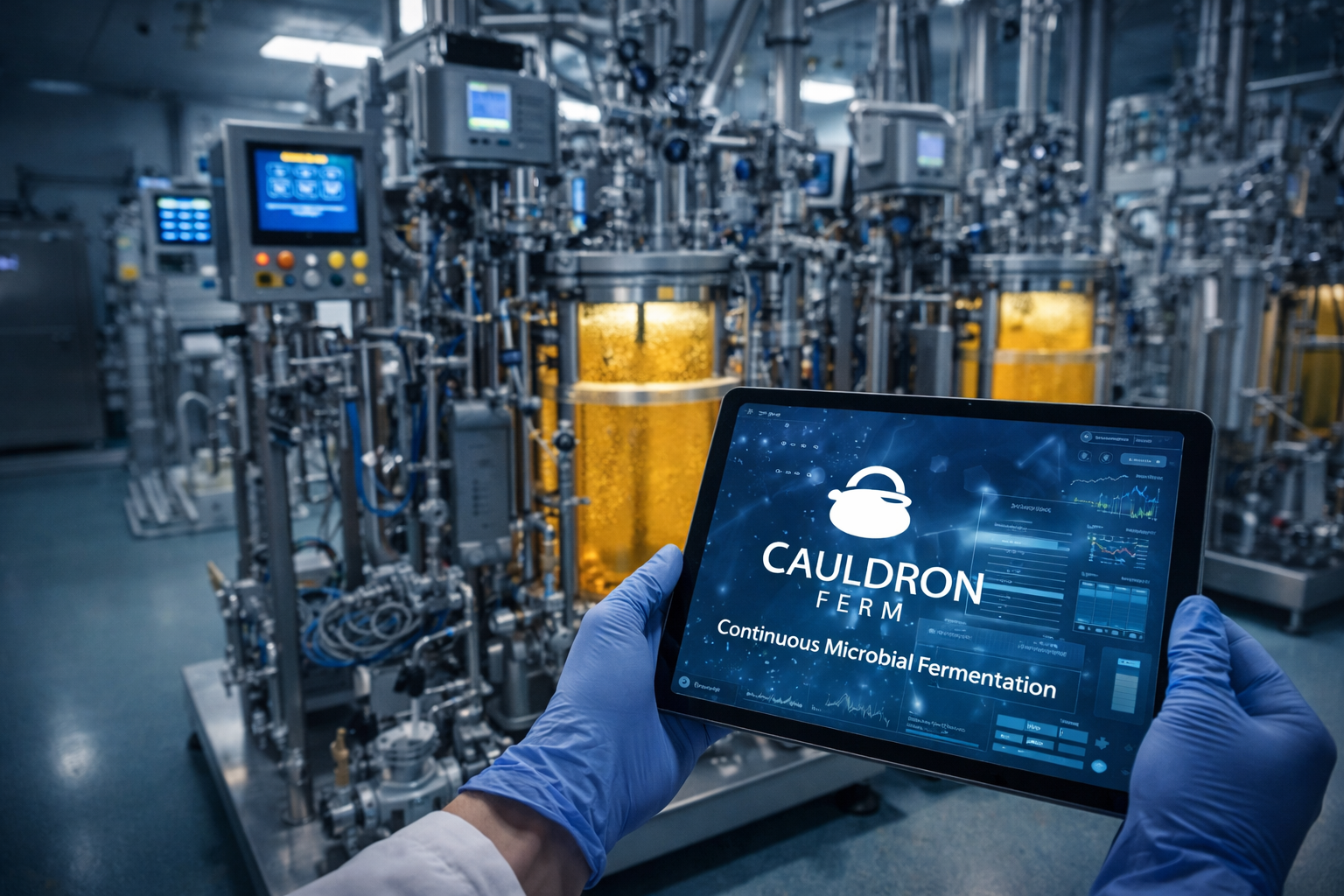
The Bio-Industrial Revolution: How Cauldron Ferm Just Unlocked Biology's Assembly Line
Key Takeaways
- Microbes are now scalable, nonstop bio-factories
- Biomanufacturing shifts from batch to continuous, slashing costs & time
- A new era of sustainable, distributed production looms
The Unseen Revolution: When Microbes Become Perpetual Factories
For decades, the promise of synthetic biology has shimmered on the horizon: engineered microbes producing everything from medicines to sustainable fuels, novel materials to lab-grown foods. Yet, a fundamental bottleneck persisted – the laborious, costly, and often intermittent nature of batch fermentation. Imagine a car factory that could only build one car, shut down, clean up, and then start over for the next. This was the silent inefficiency holding back a bio-industrial renaissance.
Enter Cauldron Ferm, an Australian startup that, according to recent reports, has not just chipped away at this problem but has obliterated it. They claim to have cracked the code, transforming what were once finite biological processes into nonstop assembly lines. This isn’t merely an incremental improvement; it’s a foundational shift, a bio-industrial revolution that promises to redefine how we conceive of manufacturing, resource utilization, and even the very fabric of our economy.
At The NexusByte, we’re not just reporting on the tech of tomorrow; we’re analyzing its tectonic implications. Cauldron Ferm’s achievement isn’t just a win for a startup; it’s a profound re-calibration of what’s possible in the macroscopic world, driven by microscopic architects.
From Batch to Biomass: The End of an Industrial Era
The conventional wisdom in fermentation has been dominated by batch processing: inoculum, growth, product accumulation, harvest, clean, repeat. It’s effective, but inherently limited by downtime, inconsistent yields between batches, and significant capital expenditure for multiple bioreactors. This model has constrained the scale and economic viability of many synthetic biology applications.
Cauldron Ferm’s success in achieving continuous bioprocessing for their customers’ engineered microbes is a monumental leap. By continuously feeding nutrients and drawing off product, they’ve unlocked a persistent state of high productivity. Think of it as moving from a series of individual sprints to an unbroken marathon, where the runners never stop, and the finish line continuously delivers output.
The Immediate Tremors: What This Means for Synthetic Biology Companies
For the legions of synthetic biology startups and established players, this news is nothing short of an earthquake.
- Economic Viability: Suddenly, previously uneconomical bioproducts might become viable. The reduction in operational costs (less downtime, fewer sterilizations, potentially smaller footprint for equivalent output) and increased throughput fundamentally alters the unit economics.
- Speed to Market: Faster production cycles mean quicker iterations, accelerating R&D and product deployment.
- Scale and Accessibility: The ability to scale production more efficiently opens doors for broader market penetration, moving biomanufacturing from niche luxury to everyday utility.
But the true impact extends far beyond the immediate beneficiaries.
The Long-Term Orchestration: Reshaping Global Industries
The vision of microbes as perpetual bio-factories, continuously churning out complex molecules, heralds a shift that will ripple across numerous sectors.
H3: Redefining Manufacturing and Supply Chains
Imagine a world where specific molecules – be they novel pharmaceuticals, sustainable polymers, or nutrient-rich proteins – are produced not in vast, centralized chemical plants, but in localized, continuously operating bio-foundries. This isn’t just about efficiency; it’s about decentralization.
- Resilience: Supply chains become less vulnerable to geopolitical shocks or natural disasters.
- Customization: Smaller, modular continuous bioreactors could allow for hyper-localized production of bespoke ingredients.
- Footprint Reduction: A continuous process often requires less physical space for the same output compared to an equivalent batch process, translating to lower land and construction costs.
H3: A Paradigm Shift for Sustainable Innovation
The ability to leverage microbial power on a continuous basis holds immense potential for the planet.
- Circular Economy: Engineered microbes can consume waste streams (agricultural, industrial) and continuously convert them into valuable products, creating genuine closed-loop systems.
- Reduced Carbon Footprint: Many bioprocesses operate at lower temperatures and pressures than traditional chemical synthesis, demanding less energy. Continuous operation amplifies these savings.
- Novel Sustainable Materials: From biodegradable plastics to synthetic silks and leathers, biomanufacturing provides pathways to replace resource-intensive and polluting materials with eco-friendly alternatives, now at an unprecedented scale.
H3: The Next Frontier of Food and Medicine
The implications for food and health are equally transformative.
- Alternative Proteins: Continuous fermentation could drastically lower the cost and increase the availability of precision-fermented proteins, accelerating the shift away from traditional animal agriculture.
- Drug Discovery and Production: The rapid, consistent production of complex biologics, enzymes, and active pharmaceutical ingredients could revolutionize drug development and access, particularly for underserved markets.
The Critical Nexus: Navigating the Bio-Future
While the enthusiasm for Cauldron Ferm’s breakthrough is well-founded, The NexusByte maintains its vigilant, analytical lens. The path from laboratory triumph to pervasive industrial adoption is rarely straightforward.
- Regulatory Frameworks: As engineered biological systems become more prevalent in industrial settings, robust and adaptive regulatory frameworks will be crucial. How do we ensure safety, traceability, and ethical deployment on an unprecedented scale?
- Public Perception and Acceptance: The notion of “engineered microbes” still carries a degree of public apprehension. Transparent communication and demonstrable benefits will be key to fostering acceptance.
- Integration Challenges: Integrating these new bio-assembly lines into existing supply chains, infrastructure, and workforces will require significant investment and strategic foresight. What new skill sets will be needed? How will traditional industries adapt?
- Scalability Beyond the Initial Breakthrough: While Cauldron Ferm has tackled a significant scaling hurdle, the journey from successful demonstration to widespread industrial deployment always presents further, unforeseen challenges. Can these continuous processes handle the sheer variety and complexity of future bioproducts?
Cauldron Ferm’s achievement is more than a startup success story; it’s a beacon signalling the arrival of the bio-industrial age. It demands a sophisticated understanding not just of the science, but of the economic, ethical, and societal implications. We are entering an era where nature itself, through human ingenuity, becomes the ultimate architect of our future. The question is no longer if biology will reshape our world, but how swiftly we can adapt to its continuous, relentless march forward.