Key Takeaways
- High-fidelity RTX power now natively integrates with Apple Vision Pro for unprecedented enterprise XR
- This partnership accelerates the shift from traditional screens to intuitive, collaborative spatial computing
- The secure, low-latency streaming of complex 3D applications unlocks new frontiers in design, engineering, and simulation
The digital world has long flirted with the physical, promising an eventual, seamless convergence. Yet, the friction points – the tethers, the latency, the computational limitations – have always remained a stubborn, albeit diminishing, barrier. Today, that barrier just got significantly thinner, perhaps even transparent, with the announcement that NVIDIA RTX-accelerated computers now connect directly to Apple Vision Pro. This isn’t just another integration; it’s a profound declaration, a strategic alignment that could fundamentally re-architect how we design, simulate, and interact within professional digital realms.
For the avant-garde technologist, this news reverberates beyond mere product synergy. It signals a critical pivot in the evolution of spatial computing, leveraging the formidable rendering capabilities of NVIDIA’s RTX platform with the meticulously engineered spatial interface of Apple Vision Pro. What was once the domain of specialized, often clunky, enterprise VR setups is now poised for a level of accessibility and fidelity previously unimaginable.
The Dawn of Unfettered Spatial Enterprise
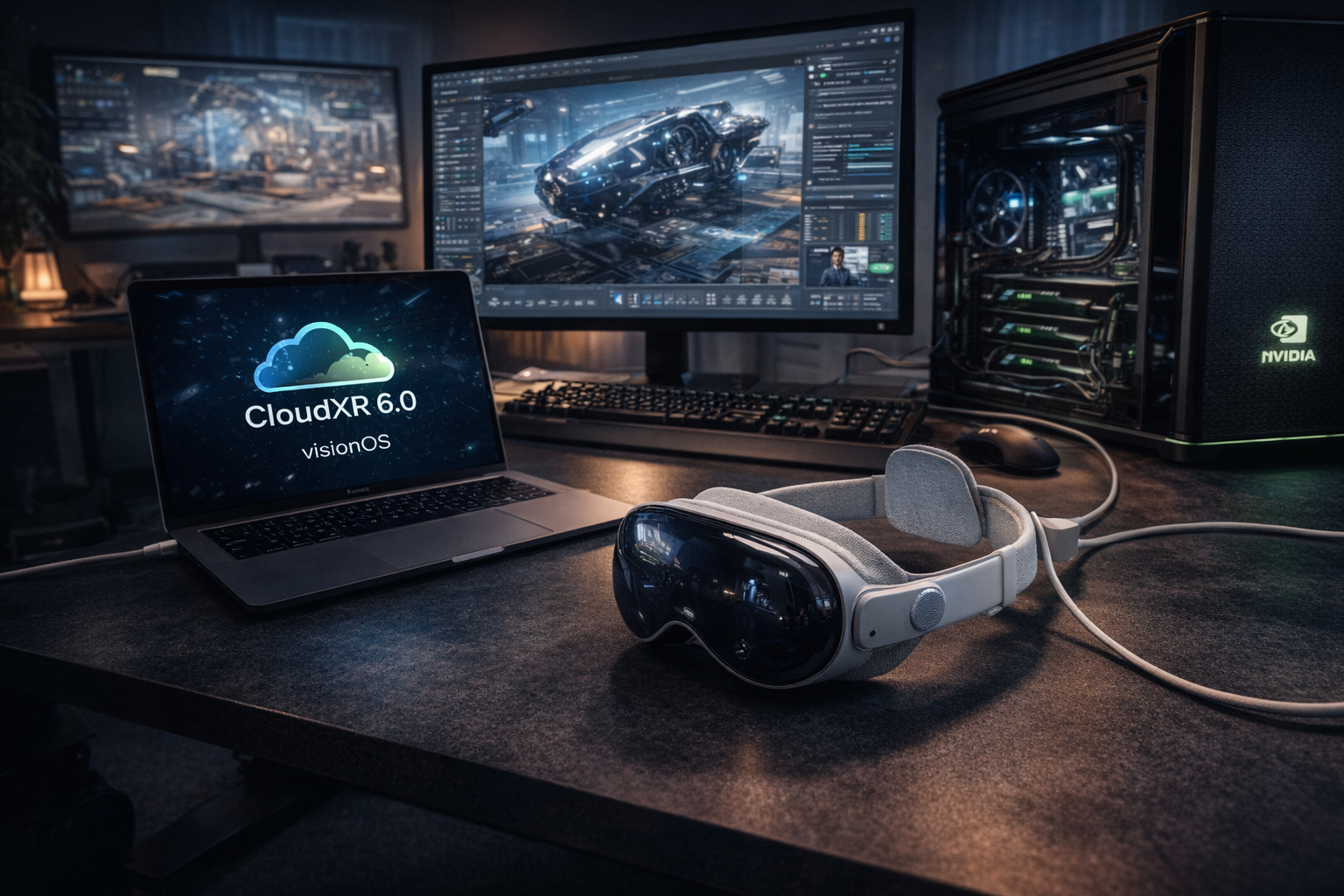
At its core, the collaboration introduces native integration of NVIDIA CloudXR 6.0 to visionOS. For the uninitiated, CloudXR is NVIDIA’s groundbreaking technology designed to stream high-fidelity augmented, mixed, and virtual reality experiences from powerful data centers or edge computers to lightweight devices. Now, Vision Pro can natively tap into the raw computational might of NVIDIA RTX GPUs, delivering complex professional 3D graphics and simulators with unprecedented visual accuracy and minimal latency.
Imagine an automotive engineer, not peering at a CAD model on a flat screen, but stepping inside a full-scale digital twin of a new vehicle, rendered in real-time with photorealistic fidelity, able to interact with every component. Picture an architect walking through a proposed skyscraper, feeling the spatial relationships, observing the play of light and shadow dynamically, all powered by an RTX farm miles away, streamed wirelessly to their Vision Pro. This isn’t a speculative future; this is the immediate potential being unlocked.
The implications for fields like product design, manufacturing, medical visualization, and even aerospace engineering are colossal. Tools such as Immersive for Autodesk VRED, powered by Innoactive’s XR streaming solutions, can now render intricate models directly into the user’s spatial environment on Vision Pro. This move bypasses the limitations of on-device processing for incredibly demanding applications, creating a dynamic duo where NVIDIA provides the muscle and Apple provides the sophisticated window into the digital world. The emphasis here is on professional applications, signalling a clear intent to move beyond consumer entertainment and into high-stakes, high-value enterprise use cases.
Reimagining Professional Workflows: From Pixels to Presence
This integration isn’t merely about higher resolution; it’s about a paradigm shift in how professionals interact with digital content. Traditional workflows often involve designers, engineers, and stakeholders gathering around 2D screens, interpreting 3D models. Spatial computing, enhanced by RTX’s capabilities, eradicates this interpretive step. Users are no longer looking at a model; they are in it, experiencing it.
The direct connection minimizes latency and maximizes visual quality, crucial for applications where precision and realism are paramount. Securely delivering these intensive applications also addresses a major concern for enterprises dealing with proprietary data and sensitive designs. The ability to stream a vast array of RTX-powered applications to a device as intuitively designed as the Vision Pro democratizes high-end XR in a way that specialized hardware could not. It positions Vision Pro as not just a consumer gadget, but a robust enterprise tool, extending its utility far beyond its initial perception.
We are entering an era where collaborative design reviews can transcend geographical boundaries, where a team scattered across continents can simultaneously inhabit and manipulate the same intricate 3D model, perceiving subtle nuances that a flat screen simply cannot convey. This fosters a level of co-creation and problem-solving that promises to accelerate innovation cycles and dramatically reduce time-to-market for complex products.
The Strategic Chessboard: Apple, NVIDIA, and the Open XR Ecosystem?
This collaboration also speaks volumes about the evolving landscape of the XR ecosystem. NVIDIA, a dominant force in high-performance computing and AI, is extending its reach into Apple’s meticulously curated hardware platform. This is a pragmatic acknowledgment of Vision Pro’s potential as a leading spatial interface for professional use cases. It hints at a future where powerful backend processing can be decoupled from the frontend viewing device, fostering a more agile and interconnected digital infrastructure.
While Apple maintains tight control over its hardware and software ecosystem, this strategic partnership with NVIDIA for CloudXR points towards a recognition that even a walled garden benefits from the most powerful adjacent technologies. It’s a subtle nod to platform agnosticism at the computational core, ensuring that Vision Pro users can access the best-in-class rendering available, regardless of its origin.
However, the road ahead is not without its considerations. While the technological promise is immense, adoption will hinge on factors such as cost accessibility for enterprises, the readiness of the developer community to fully leverage these new capabilities, and the continued refinement of the user experience within visionOS for sustained professional use. The learning curve for truly intuitive spatial interaction, while significantly smoothed by Apple, still exists.
Ultimately, this integration marks a pivotal moment. It’s not just about a powerful GPU talking to a sophisticated headset; it’s about the convergence of leading-edge hardware and streaming software to dissolve the remaining barriers to truly immersive, high-fidelity spatial computing for the enterprise. The NexusByte believes this partnership is a foundational block in building the digital work environments of tomorrow, where presence is paramount, and the boundaries between our physical and digital realities elegantly fade. The future of professional interaction just got a significant upgrade.