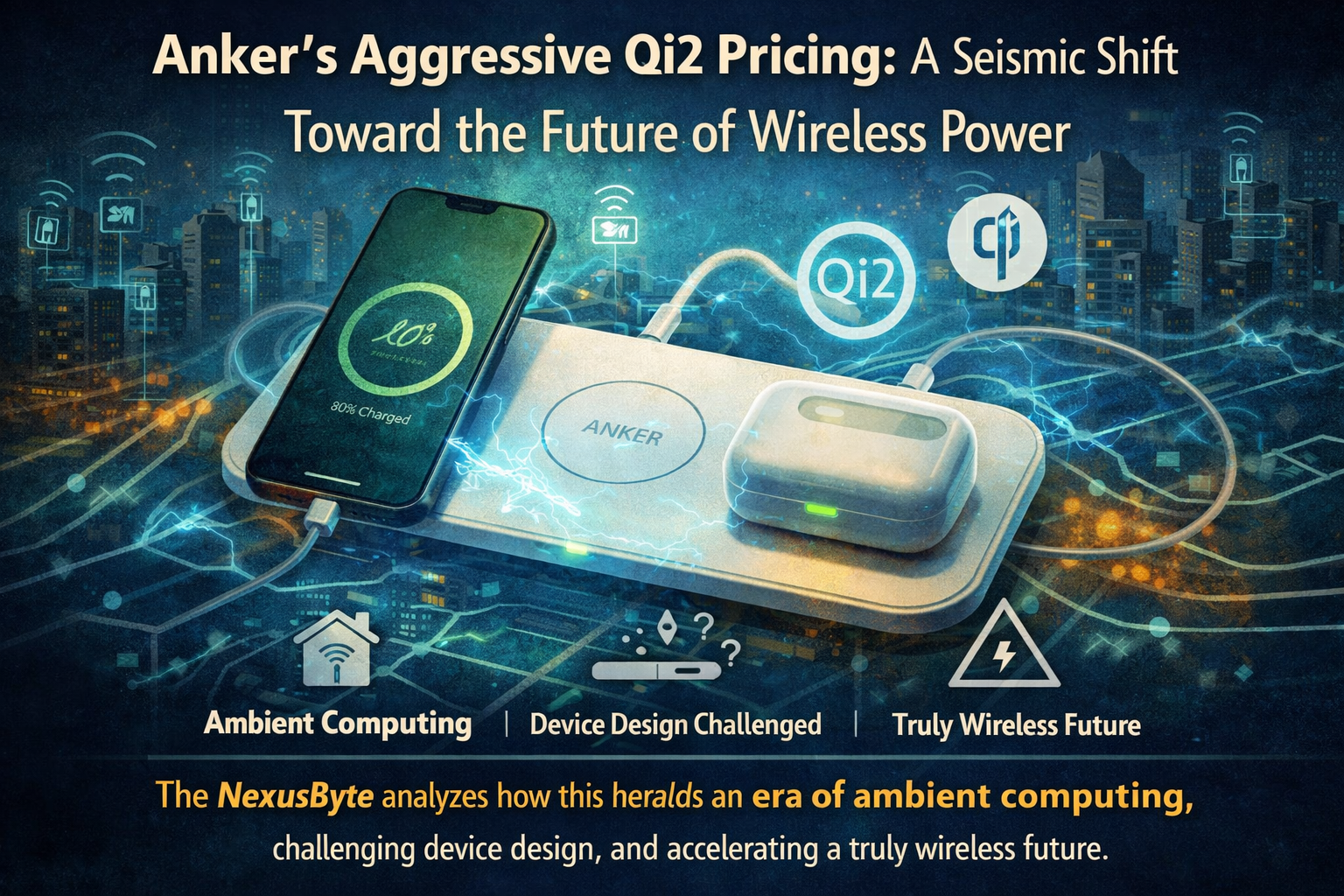
The Invisible Tether Severed: Anker's $15 Qi2 Pad and the Architecture of Effortless Power
Key Takeaways
- The $15 Qi2 standardizes premium wireless charging, accelerating its ubiquity across ecosystems
- Device design will fundamentally evolve without port dependency, fostering thinner, more resilient gadgets
- This affordability is a critical enabler for ambient computing, where power becomes an invisible, ever-present utility.
The Ephemeral Tether: A Precursor to Liberation
For years, “wireless charging” has occupied a peculiar niche in our technological consciousness. Often relegated to a minor convenience, a subtle luxury that spares us the momentary indignity of fumbling for a cable, its true transformative potential has remained largely untapped. We’ve accepted the minute savings, the uncluttered nightstand, without truly grasping the deeper architectural shifts it portends. Yet, the recent revelation that Anker is offering a Qi2-certified wireless charging pad for a mere $15 is not just another product launch; it is a semantic shift. This seemingly modest price point is poised to catalyze a profound re-evaluation of our relationship with power, pushing us inexorably towards a future where energy is not managed, but simply is.
Qi2: The Unspoken Standard Bearer
Before we dissect the implications of its affordability, it’s crucial to understand why Qi2 is more than just “faster Qi.” The original Qi standard, while revolutionary, often suffered from misalignment issues and comparatively sluggish charging speeds, making it a pragmatic choice only when convenience trumped efficiency. Enter Qi2. Born from a collaboration with Apple’s MagSafe technology, Qi2 integrates magnetic alignment, ensuring optimal coil placement for consistent 15W power delivery. This isn’t just about speed; it’s about reliability and consistency, transforming wireless charging from an occasional indulgence into a dependable, primary mode of power transfer. By essentially democratizing the premium magnetic charging experience pioneered by Apple, Qi2 establishes an open, cross-device standard that was conspicuously absent until now.
The $15 Imperative: Democratizing the Future
The critical inflection point here is not the technology itself, but its price. A $15 Qi2 pad isn’t just competitive; it’s disruptive. This aggressive pricing strategy by a market leader like Anker signals a deliberate intent to accelerate mass adoption.
What does this translate to in the long term?
- Ubiquitous Integration: At $15, these pads become impulse buys, not considered purchases. They become disposable accessories, making it economically viable to embed them everywhere: office desks, coffee shop tables, car dashboards, integrated furniture, public spaces. The vision of truly ambient power, where devices are passively topped up simply by existing in proximity to a charging surface, moves from speculative fiction to imminent reality.
- Ecosystemic Pressure: The democratization of premium wireless charging will inevitably exert immense pressure on other accessory manufacturers and even device makers. What was once a differentiating feature for high-end phones and accessories will soon become a baseline expectation across all price tiers.
- Accelerated Replacement Cycle: As consumers upgrade to Qi2-compatible devices, the incentive to embrace the technology fully grows stronger, fostering a positive feedback loop that solidifies its position as the de facto standard.
The Long Echo: Redefining Device Architecture and Interaction
The proliferation of affordable, high-speed, magnetically aligned wireless charging carries implications far beyond mere convenience. It fundamentally challenges our assumptions about device design and user interaction.
The Portless Imperative
Imagine a future where the charging port—be it USB-C or Lightning—becomes an anachronism. A pervasive wireless power infrastructure renders physical ports largely redundant for power delivery. This opens up unprecedented design freedoms:
- Sleeker Aesthetics: Devices can be thinner, sleeker, and more minimalist, unencumbered by the necessity of a physical aperture for charging.
- Enhanced Durability: Eliminating a significant point of ingress makes devices inherently more resistant to water, dust, and physical wear and tear, improving longevity and reducing repair costs.
- New Form Factors: Without port constraints, manufacturers can experiment with radical new device geometries, modular designs, or even fully sealed devices.
Ambient Computing: A Foundational Layer
The ultimate promise of ubiquitous wireless power is its role as a foundational layer for ambient computing. In a truly ambient environment, technology recedes into the background, seamlessly integrating into our lives without demanding explicit interaction. Constant power is a prerequisite for this vision. When battery anxiety vanishes because devices are always passively charging, our relationship with technology shifts:
- Always-On Intelligence: Wearables, smart home sensors, and even augmented reality devices can operate with persistent connectivity and processing power, without the intermittent downtime for manual recharging.
- Seamless Interaction: The mental load associated with power management dissipates, allowing users to focus entirely on interaction and content, accelerating the adoption of hands-free interfaces and predictive AI.
- From “Charging My Phone” to “My Phone Is Charged”: This subtle linguistic shift encapsulates a profound change in user expectation – power transitions from a managed resource to an ever-present utility.
The Critical Lens: Unseen Costs and Persistent Challenges
While the enthusiasm for a wirelessly charged future is palpable, a nuanced perspective demands a critical examination. Is the proliferation of numerous small chargers truly more sustainable than a single, universal cable? Wireless charging, by its nature, is less energy-efficient than wired charging due to energy loss in electromagnetic transfer, raising questions about aggregate power consumption. Furthermore, while the tether to the wall is severed, we are merely replacing it with an invisible tether to a pad. True, unfettered wireless power, perhaps via over-the-air energy harvesting, remains the ultimate frontier, making Qi2 an intermediary step rather than the final destination. These are not minor footnotes; they are essential considerations that must temper our techno-optimism.
The NexusByte’s Prognosis: A Charge Towards Invisible Infrastructure
Anker’s $15 Qi2 pad is more than a bargain; it’s a strategic accelerant. It’s a deliberate push to dismantle the last ubiquitous physical tether connecting us to our devices, hastening the arrival of an age where power is an assumed, invisible infrastructure. As this foundational layer solidifies, we stand on the precipice of witnessing truly transformative shifts in device design, user experience, and the very architecture of ambient intelligence. The seemingly mundane act of setting down your phone now carries the weight of a future being silently, magnetically, powered into existence. What other “invisible” infrastructures will emerge next, profoundly reshaping our technological landscape? The journey has just begun.